Quick Answer
Istanbul is built across two continents and carries three major civilisations—Roman, Byzantine, and Ottoman—layered into the same streets and monuments. The historical core spans from Topkapı Palace and Hagia Sophia to the Blue Mosque and the Basilica Cistern, all within walking distance in Sultanahmet. The city’s museums, covered bazaars, and Bosphorus geography make it essential to organise a visit by district rather than random attraction-hunting; three focused days yield far more understanding than a scattered week.
A City of Layers
Istanbul is easy to romanticise and difficult to summarise. A population of eighteen million, a geography split between two continents by the Bosphorus, and a succession of empires that built on top of each other rather than starting fresh. Walking the streets of the old city, you step on Roman, Byzantine, and Ottoman ground in the same afternoon — sometimes in the same square.
I have been guiding visitors through Istanbul for over two decades, and the approach I find most useful is to let the monuments speak in sequence. What follows is a district-by-district account of the major sites, starting from Sultanahmet — the point where most visitors begin.
Sultanahmet Square and the Hippodrome
The open area in front of the Blue Mosque was once the Hippodrome, Constantinople’s principal arena. Modelled after the Circus Maximus in Rome, it was begun by Septimius Severus in 203 CE and vastly enlarged under Constantine I, who completed it in 325. In its final form, the Hippodrome was horseshoe-shaped, measuring roughly 400 by 120 metres, and could seat 100,000 spectators across forty rows.
High walls enclosed the arena on three sides. The emperor’s loggia occupied the eastern side. Down the centre of the track ran the Spina — a raised pavement that kept chariot traffic in order. Columns and statues from across the empire were erected along the Spina. Among those known to have stood here were a warrior in combat with a lion, a dying bull, the Heracles of Lysippos, a wild horse, an eagle catching a snake, portraits of the emperors Gratianus, Valentinian, and Theodosius, and figures of prizewinning charioteers. The statues were of bronze or marble. Over the emperor’s loggia, set on two towers, stood four bronze equestrian figures — the work of Lysippos — now in the Piazza of St Mark’s, Venice, removed by the Latins during their thirteenth-century occupation of the city.
The racing teams — Reds, Yellows, Blues, and Whites — were large organisations with their own stables and stud farms. Over time these factions attached themselves to political movements, and the Nika insurrection grew directly from their rivalries. To suppress such unrest, successive emperors curtailed the games until they were forbidden altogether. The Hippodrome became a parade ground and ceremonial space.
The Latins inflicted the worst damage. The crusading army stripped every metal artefact it could find — including the bronze statues on the Spina — and melted them down for coin. After the Turkish conquest, the Hippodrome was restored as a centre of ceremony and entertainment. The finest Turkish monuments of the era were built around it: the İbrahim Paşa Palace, the Ayasofya Baths, and the Sultanahmet Mosque. Three ancient monuments still stand on the site of the original Spina.
The Monument of Theodosius (Egyptian Obelisk)
An ancient Egyptian monolith, originally erected by Tutmosis III (1504–1450 BCE) before the temple of Karnak at Heliopolis. It stands 25 metres tall in red porphyry. The hieroglyphic inscription describes the pharaoh’s victories; at the top, the pharaoh kneels at the foot of the god.
The obelisk was brought to Constantinople in 390 CE by the emperor Theodosius I and raised on a rectangular stone base supported by four bronze feet. The marble base alone is six metres high and covered in relief carving. The northern face shows scenes from the erection of the monument — the emperor watching it being set in place. The eastern face depicts the emperor and his family watching chariot races. The southern face shows the imperial family in the loggia during the games. The western face presents the emperor’s defeated antagonists prostrated before him. Inscriptions in Greek and Latin flank the reliefs.
Constantine’s Column
Although not precisely dated, this monument is thought to be from the fourth century. It stands 32 metres tall in sandstone ashlar masonry. Originally it was revetted with gilded bronze plaques, which were stripped during the Latin invasion of 1204, melted down, and minted. Constantine VII Porphyrogennetos (913–959) restored the column and added inscription plaques recording his grandfather’s achievements. The marble inscription on the base reads: “Constantine restored this now ruined monument to a state better than the original.” Excavations around the base have revealed fountains on all four sides.
The Serpent’s Column
One of Istanbul’s oldest monuments. It is part of a larger monument commemorating the victory of thirty-one Greek cities against the Persians at Salamis and Plataea in 479 BCE. Originally presented to the temple of Apollo at Delphi as a tripod cauldron base, it was cast from Persian weapons gathered as spoils after the Greek victory.
The spiral column took the form of three intertwined serpents, their heads supporting a gold cauldron. Two of the serpent heads survive — one in the Istanbul Archaeological Museum, the other in the British Museum. The third is lost. The present column stands 5.5 metres, though the original was 8 metres. It was probably brought to Constantinople and erected by Constantine.
Sultanahmet Mosque
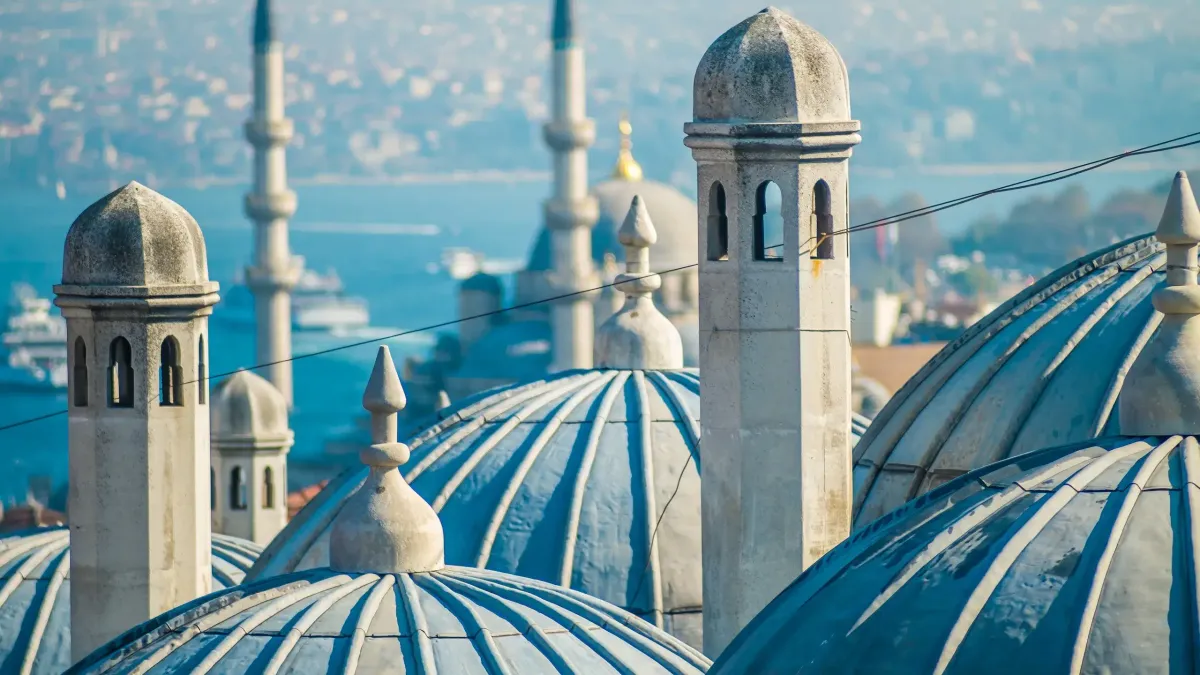
Built between 1609 and 1616 by the architect Sedefkar Mehmet Ağa for Sultan Ahmet I. Its six minarets are distinctive — the only imperial mosque in Istanbul with that number. Surrounded on three sides by courtyards with five portals, the portico is covered by thirty cupolas supported on twenty-six marble columns with stalactite capitals. A hexagonal fountain stands in the centre of the main courtyard. The mosque itself has three doors; the largest opens onto the main courtyard and serves as today’s entrance.
The plan is almost square. The central dome rests on four marble piers with four arches sprung between them. Semi-domes flank the main dome on all four sides, with cupolas at the corners. The dome rises 23 metres, and the extraordinary height allowed for 260 windows, filling the interior with a warm, even light that illuminates the rich tiling and tracery. According to the sources, there are 21,043 faience tiles, each valued at eighteen silver akçes.
The sultan’s gallery sits in the left corner and features a fine mihrab decorated with mosaic and green tiles. The mother-of-pearl inlay door, gilded faience, and filigree relief-carved marble balustrades are exceptionally fine. The mosque is commonly known as the Blue Mosque after its faience revetments — those on the gallery level are particularly noteworthy. The blue-green faience wall panels are echoed by tracery on the dome in similar tones. The dome also carries the names of the caliphs, inscribed by the calligrapher İzzet Efendi.
It was from the steps of the marble pulpit that Mahmut II declared the dissolution of the Janissaries in 1826. The mihrab, in white marble, is decorated with precious stones and a piece of rock from the Kaaba. The mausoleum of Ahmet I stands to the northeast, alongside those of Osman II and Murat IV. Until the nineteenth century, the Sultanahmet Mosque was the traditional starting point for the pilgrimage to Mecca.
The Underground Cistern
Ancient cities had to secure their water supply against siege. Istanbul possessed a series of large cisterns built with this in mind — some open, others covered. The covered cisterns were square or rectangular in plan, roofed with brick arches and vaults on stone piers.
The Yerebatan Sarnıcı is one of the largest covered cisterns of the era. It sits not far from Hagia Sophia, and the district is named after it. In the Byzantine period it was called the Basilica Cistern. First constructed under Constantine I (306–337), it was restored and extended by Justinian (527–565). The cistern measures 141 by 73 metres. Twelve rows of twenty-eight columns each — 336 in total — support the superstructure. The columns stand eight metres tall and are topped with composite capitals.
Topkapı Palace
After the conquest of Istanbul, Mehmet II chose a site on the Forum Tauri (today’s Beyazıt Square) for his first palace — a walled complex that no longer survives, though it appears in old maps on the site of the present Istanbul University. The old palace later became the residence of harem members who had fallen from favour or wives of previous sultans.
Not long after the conquest, Mehmet II began a new palace at Seraglio Point, which became known as Topkapı Saray after a nearby shore palace by the Cannon Gate of the sea walls. The walls surrounding the point — the first hill of the city — ran 1,400 metres, linking the old Byzantine sea walls on the Sea of Marmara and the Golden Horn with land walls supported by twenty-eight towers. The main gate was the Imperial Gate — Bâb-ı Hümâyûn — behind Hagia Sophia.
Construction began between 1472 and 1478 and continued through successive reigns, with additions made into the mid-nineteenth century. The complex includes lodges, pavilions, quarters, a mosque, a library, and an immense kitchen. The last pavilion built on the site was the Mecidiye Köşkü, now open as a restaurant. Several pavilions on the point were lost in a fire in 1863 and disappeared entirely during construction of the Sirkeci railway.
Topkapı became a museum in 1924.
The First Court
Also called the Ceremonial Court — Alay Meydanı. On the right stand the former offices of the Ministry of Finance (Defterdar Dairesi); on the left, Hagia Eirene, which served as the Ottoman armoury.
The Second Court
Entered through the Bâbüsselâm (Gate of Salutation), flanked by towers, dating originally to Mehmet II with alterations under Süleyman I and a broad-eaved bay added under Mustafa II. This court marks the true entrance to the grounds of the Saray-ı Cedid — the New Palace.
On the right: the pantry guards’ barracks, the kitchens built by the architect Sinan, the cooks’ dormitories, a bath, the chief steward’s offices, and the larder. On the left: the barracks of the Crested Halberdiers, the imperial stables, the livery treasury, and the mosque of Beşir Ağa. Further along the left side are the double-domed chambers that housed the Imperial Council of Viziers — built by Süleyman I, this was the seat from which the state was governed. A rectangular watchtower adjoins the chambers, built under Mehmet II and given its present appearance under Abdülmecit.
The Harem is entered through a door beside the council chambers. To the right is the entrance to the imperial records office.
The Third Court
Entered through the Gate of the White Eunuchs, dating to the reign of Selim III. The imperial throne was set beneath its broad eaves during ceremonies of allegiance, religious celebrations, and public audiences. The gate was flanked by the chambers and barracks of the White Eunuchs.
This court contains the Throne Room — built under Mehmet II, with its door and decorations dating to the nineteenth century. Overhanging eaves cover a columned arcade, and the walls are revetted with faience. The room served principally for imperial audiences with viziers and foreign envoys.
Behind the Throne Room stands the Library of Ahmet III, the largest and finest library in the palace. On the right of the court: the Enderun school, the artists’ and musicians’ atelier, the barracks of the Campaign Pages, and the Treasury — a former pavilion from Mehmet II’s time. Remains of a bathhouse dating to Selim II are also here. On the left: the Treasury of the Sword-Bearer (Silahdarağası Hazine) and the apartments of the sacred relics. Further left is the vaulted Mosque of the White Eunuchs — the Akağalar Mosque — now housing manuscripts collected from across the palace.
The sultan’s privy kitchen is a small building behind the mosque, next to the second entrance to the Harem.
The Fourth Court
Two slightly ramped alleys lead from the third to the fourth court — a spacious garden sometimes called the Tulip Garden, though the actual name is the Lala’s Garden (the misnomer comes from the word lale). The chief court physician’s tower stands at the terrace edge overlooking a lower garden and served as the palace pharmacy.
On a terrace wall stands the Pavilion of Mustafa Paşa — also known as Sofa Köşkü — dating to the early eighteenth century, decorated with occidental-inspired motifs within a traditional Turkish framework.
To the left, a stone-paved terrace adjoins the chambers of the sacred relics. At one end stands the Revan Pavilion (Şevk Oda), built by Murat IV in 1635 — its manuscripts were later transferred to the museum library. At the other end, commanding the Golden Horn and the Bosphorus, is the Baghdad Pavilion, built after Murat IV’s second conquest of Baghdad. Its interior — decorative dome, vaults, and mother-of-pearl inlaid doors — is among the most accomplished in the palace.
At the terrace edge overlooking the city is a gilded bronze baldachin with four columns supporting an eaved cupola, built by Sultan İbrahim as a place of vigil.
Opposite the relics chambers is the Circumcision Room, also built by Sultan İbrahim in 1641, decorated with fine sixteenth-century tile panels reused from earlier buildings. The window panels contain small fountains, and a long poem is inscribed on the facade.
On the Marmara side of the fourth court stand the Çadır Pavilion and the Mecidiye Pavilion, built by Abdülmecit I in European style — the last building erected in the palace complex. It is flanked by a small wardrobe room and the Sofa Mosque, a chapel mosque with minaret. A path descends from the Mecidiye Pavilion to a gate opening onto what is now Gülhane Park.
The Harem
The Harem is a separate complex within the palace. The main entrance is through the Carriage Gate (1558) from the second court, with a second entrance from the third court (the Kuşhane Gate) and a third (the Sal Gate).
Over four hundred years, the Harem was added to, restored, and altered repeatedly. It contains 250 rooms, several baths, and inner courts. Notable quarters include the apartments of the Black Eunuchs (who administered the Harem), the slaves’ apartments and hospital, the apartments of the heir elect and the dowager sultan, the crown princes’ chambers, and the rooms of the favourites. The sultan’s privy chambers formed a complex in themselves. Some court retainers lived in the Harem section as late as 1908.
The range of faience from different periods is one of the Harem’s most striking features. The museum collection includes Chinese and European porcelain, arms and armour, costumes, carriages, jewellery, encrusted medals and medallions, precious metalwork, and a collection of paintings.
The Tiled Pavilion — Çinili Köşk
Within the boundaries of the first court, now behind the Museum of Archaeology. Built by Mehmet II in 1472, also called Sırça Saray (Glazed Palace), its architecture and decoration follow a Central Asian Turkish tradition. A fountain and pool were added under Murat III in 1590. The first museum in Istanbul was founded here in 1875.
The pavilion is two-storeyed, with a central domed hall and four axial bays, rooms opening at the corners — a plan also found in traditional Turkish houses. Faience inscriptions decorate the facade. It now serves as a pottery and tile museum, housing İznik tiles and Çanakkale pottery.
The Grand Bazaar
Istanbul’s largest covered market, founded by Mehmet II in 1461 to provide traders with a secure place of business. Enlarged under Süleyman I and rebuilt to its present plan in 1701. The market holds sixty-five streets within a covered area of 30,702 square metres, surrounded by numerous hans (trading inns) that connect to the interior.
Today the bazaar contains a mosque, a mescit (chapel mosque), twenty-one hans, two bedestens (secure trading halls), seven fountains, one well, one sebil, one şadırvan, and 3,300 shops. It has eighteen portals — eight grand, the rest smaller. The doors close at 7 p.m., and roughly fifty guards patrol the bedesten overnight.
The Arab traveller Ibn Battuta, visiting Istanbul with a Kipchak caravan about a century before the Turkish conquest, mentions a market in this area. The bazaar was destroyed by fire five times — the fires of 1546 and 1651 caused the worst damage. An earthquake in 1894 and fires in 1954 destroyed more than half the historic fabric.
The two bedestens — the Sandal Bedesten (New Bedesten, built by Mehmet II) and the Cevahir Bedesten (Old Bedesten, reserved for antiques) — are the market’s structural core. The Cevahir Bedesten was built over Byzantine-period walls and is covered by vaults and cupolas on eight piers, totalling 1,336 square metres. During the Ottoman period, valuable fabrics, furs, weapons, and rugs were traded here — effectively a merchant treasury.
The Süleymaniye Mosque and Complex
One of the finest examples of Islamic architecture. The complex includes six medreses, a tabhane (guesthouse), an imaret (soup kitchen), a caravanserai, a mental hospital, baths, a school, shops, and the mausoleums of Süleyman I and Hürrem Sultan (Roxelane).
Built between 1550 and 1557 by the architect Sinan for Süleyman I (r. 1520–1566). The mosque has four minarets — two with two galleries, two with three — ten galleries in total, said to symbolise the fact that Süleyman was the tenth Ottoman sultan.
The mosque measures 69 by 63 metres. The central dome is 53 metres high and 27.25 metres in diameter, with 32 windows in the drum. It rests on four grand piers of monolithic porphyry, connected by four arches. Two semi-domes to east and west flank the main dome, and two auxiliary naves with galleries are covered by five cupolas of varying sizes.
The mihrab and minber are of white marble. The stained-glass windows in the mihrab wall are original sixteenth century. The faience revetment surrounding the mihrab and the mother-of-pearl and ivory inlaid doors are rare works of art. The decoration throughout is restrained and balanced.
The courtyard is surrounded by a cupola-covered arcade — twenty-four white marble and red granite columns from the Hippodrome support twenty-eight cupolas. A rectangular fountain stands in the centre. A bronze grille encloses the nave on the left, later converted to a library.
The mosque was built with materials from great distances as well as from older buildings within the city: one pier from Baalbek, another from Alexandria, a third from the court of the old palace, a fourth from Fatih. East of the mosque stand the mausoleums of Süleyman and Hürrem Sultan. The tomb of Süleyman — Sinan’s work — is octagonal and domed, supported by eight porphyry columns, decorated with polychrome faience and stained glass. Inscribed stones discovered on the eave in 1959 proved to be fragments of a stone-carved inscription from Hagia Sophia, part of a decree by the Byzantine emperor Manuel I.
Close to the Süleymaniye stands the tomb of the architect Sinan. In the words of one Turkish writer, it is set like a small signature in the corner of a grand painting.
Rüstem Paşa Mosque
One of Sinan’s finest works outside his imperial commissions. Situated in Tahtakale, the old city’s trade centre, it was built around 1561 for Grand Vizier Rüstem Paşa. Concerned that the mosque not be lost among the surrounding market buildings, Sinan raised it on deep vaults — the vaults themselves used as shop space. There is no large court; the mosque is reached by flights of steps.
The central dome is flanked by four semi-domes and supported by eight piers. Galleries line the main area. The interior is covered with tiles from İznik and Kütahya — among the finest tile programmes in Ottoman architecture. Rüstem Paşa also built a han nearby and a medrese on the slope leading up to the Süleymaniye.
The Spice Market (Mısır Çarşısı)
Istanbul’s second covered market. Built by Hatice Turhan Sultan, mother of Mehmet IV, as part of the Yeni Mosque foundation. Construction was begun by the architect Kasım Ağa and completed by Mustafa Ağa in 1660. The building is L-shaped in plan, last restored in 1943 when the raised wooden counters of the old shops were replaced with modern fronts.
The structure is dressed stone with alternating brick courses serving as both reinforcement and exterior ornament. Stone finials surmount the domes; mouldings and gutters are fine examples of Ottoman detail. The market has six gates and eighty-six shops, with three porticoed gates giving the building visual articulation.
Kariye (Chora)
This monastery church was built outside the city walls in the fourth century under Constantine I — “Chora” being Greek for the countryside. It came within the walls built by Theodosius II (408–450). Much damaged by an earthquake in 558, it was restored by Justinian (527–565) but kept its original name.
The present building — a dome on four piers — was built by Maria Dukania, mother-in-law of Alexius Komnenos (r. 1081–1118), and dedicated to Christ. During the reign of Andronikos II (1282–1328), the Grand Logothetes Theodoros Metochites — a sage and philosopher who lived nearby — devoted his entire fortune to a thorough restoration. He added an exonarthex and parecclesion, both decorated with mosaics and frescoes of the highest quality, dated between 1305 and 1320.
When Andronikos Palaiologos III came to power (1328–1341), Metochites was exiled and his fortune confiscated. On his return, he lived as a simple monk in the monastery. He was buried before the door to the inner narthex.
The church was converted to a mosque by Bayezid II (1481–1512). It is now preserved as a historical monument. The mosaics were cleaned and restored by the American Byzantine Institute.
The Mosaics
In the nave at the apse: on the left wall, Christ stands with the inscription “Come unto me, all ye that are burdened with suffering.” On the right, the Virgin holds the Christ child.
Over the door from the nave to the narthex is the Dormition (Koimesis) of the Virgin. She lies on her bier surrounded by the apostles. Christ stands in the centre, ready to bear her soul — represented as a newborn babe — to heaven. Buildings in the background break up the composition.
Above the door from the narthex to the nave, Theodoros Metochites presents a model of the church to Christ. The Logothetes wears a caftan-like robe and large turban-like headgear, kneeling in reverence.
The two domes of the narthex contain mosaics of Christ’s genealogy, portraying his ancestors beginning with Adam. The Life of the Virgin occupies the narthex walls — from the Annunciation to Saint Anne through to the Annunciation to the Virgin. The Life of Christ follows in the exonarthex.
The Deesis — the largest mosaic panel in the church — is on the south wall of the narthex. Christ is flanked by the Virgin on his right; unusually, there is no John the Baptist on his left. On the left of the panel, Saint Maria stretches out her hands in supplication. At her feet kneels a prince identified by inscription as Isaakios Komnenos, son of Alexius Komnenos I. On the right stands Melania, queen of the Mongols, dressed as a nun.
Over the door from the exonarthex to the narthex is Christ Pantocrator, titled “Chora ton Zonton” — linking the church’s name with “the land of the Living.” He holds the Bible in his left hand and blesses with his right. The entire exonarthex is devoted to the Life of Christ: the Infancy on the lunettes, the Ministry — including Baptism and Miracles — in the vaults.
The Parecclesion
The funeral chapel on the south side of the church. Being a place of burial, fresco was chosen over mosaic — a more restrained medium for this purpose. The chapel is five metres wide and sixteen metres long, divided in two. The burial section is rectangular and domed, flanked by niches containing tombs of Byzantine notables.
A fresco of the Virgin and Child with guardian angels decorates the dome. In the apse is the Anastasis (Resurrection): Christ within a nimbus holds Adam and Eve by the hand as they rise from their tombs. To his right stand the apostles; to his left, the saints. Beneath his feet lies Satan, bound with chains.
The main vault shows the Last Judgement and the Second Coming of Christ. He sits in judgement, the Virgin to his right, John the Baptist to his left, both interceding for humanity. The fresco is notable as one of the first fourteenth-century church representations of a large group of unclothed figures. The walls carry military saints — reflecting their popularity during the empire’s final years.
What Remains
Every visit teaches me something I missed the time before. The layers are deep enough that a guide who has worked this city for decades still finds unfamiliar inscriptions, unexpected angles, overlooked details. A city that served as the capital of three empires does not give up its full measure quickly — and that is what keeps visitors coming back.
Frequently Asked Questions
How many days do I need to see Istanbul properly? Three focused days structured by district work better than a scattered week. Day 1 covers Sultanahmet (Topkapı, Hagia Sophia, Blue Mosque, Basilica Cistern). Day 2 is museums and bazaars (Archaeological Museum, Turkish and Islamic Arts, Grand Bazaar). Day 3 includes the Bosphorus cruise and modern districts. Five days allow slower exploration and side visits to neighbourhoods like Balat or Eyüp.
Is Hagia Sophia currently open to visitors? Hagia Sophia was reconverted to a mosque in 2020 and operates as an active mosque with restricted visiting hours. Non-Muslim visitors can enter during certain times, though you may not be able to access all sections. Check current visiting guidelines before planning. Many of the mosaics are covered, and the experience differs from when it functioned as a museum.
Should I visit the Grand Bazaar or the Spice Bazaar? Both are worth entering but serve different purposes. The Grand Bazaar is the Ottoman-era covered market with sixty-five streets and over three thousand shops — textiles, ceramics, carpets. The Spice Bazaar focuses on food, herbs, and seasonings and is more compact. If time is limited, the Grand Bazaar captures the market tradition more completely, though both are easier visited together in a morning.
What is the Basilica Cistern and why should I visit it? A vast underground water supply built in the sixth century, supported by 336 recycled columns, it served Constantinople during sieges. Walking below the city gives a different perspective on Byzantine engineering and resource management. It is atmospheric, relatively quiet, and often overlooked by visitors focused on the major monuments above ground.
Can I cross the Bosphorus by cruise in one day? Yes. A ferry crossing or a short cruise (30–60 minutes) is the simplest approach. A longer Bosphorus cruise that departs from the Golden Horn or Galata covers both shores and takes 1.5–2 hours, explaining the palaces, mosques, and villas visible from the water. This is how Istanbul geography actually makes sense.
Are photographs allowed in the mosques? Many mosques allow photography outside prayer times; some restrict it entirely. Hagia Sophia and the Blue Mosque have variable policies depending on the time of day and crowds. Always ask the guard or attendant before photographing inside. Respect is expected — remove shoes, cover shoulders, avoid pointing cameras at worshippers.