Quick Answer
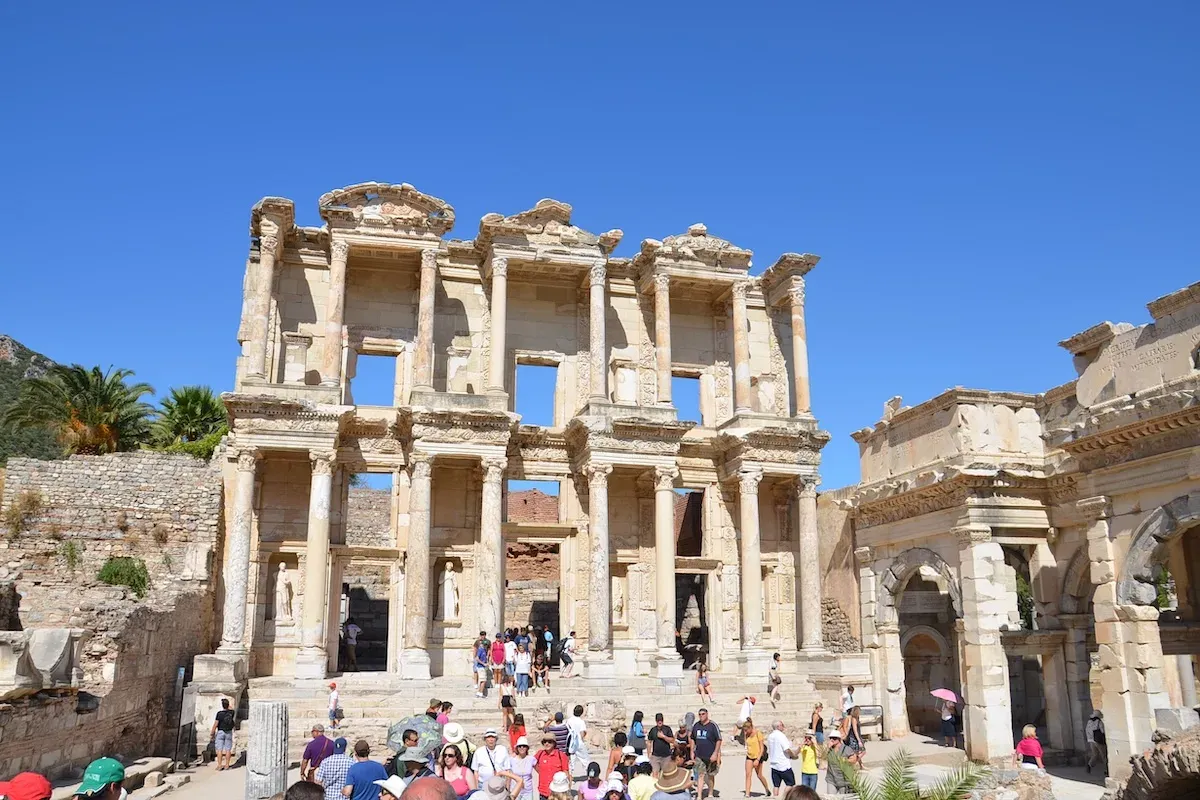
The historical context of the Library of Celsus, terrace houses and changing harbour landscape is documented in UNESCO’s Ephesus site description. That record distinguishes the surviving Roman monuments from the remains of the Temple of Artemis.
Ephesus was one of the classical world’s most important cities and moved four times as harbours silted and politics shifted, eventually settling on the slopes of Bülbüldağ and Panayırdağ in the Roman period. The visible ruins—the Library of Celsus, the Theatre, the Temple of Hadrian, the Odeon—date primarily to the second and third centuries CE, when Ephesus was the commercial hub of Western Anatolia. The site is one of Turkey’s richest archaeological locations, and understanding the city’s movement sequence is essential to reading what the stones are telling you.
A City That Moved
Ephesus is not one city. It is at least four, each built in a different location as harbours silted up, rulers changed, and the coastline shifted. Understanding that sequence is the difference between walking through photogenic ruins and actually reading what the stones are telling you.
According to tradition, the city was founded by Androklos, a son of the legendary King Kodros, though Lelegians and Carians lived in the area earlier. Like the other Ionian settlements along the Aegean coast, Ephesus was colonised by the tenth century BCE at the latest. The Greeks who arrived found the Anatolian mother goddess Kybele already established as the dominant deity. Rather than displace her, they merged her worship with that of Artemis — a practical act of syncretism that kept the local population settled and the temple functioning.
The original settlement stood about 1,200 metres west of the later Artemision, at the port of Koressos. In its early centuries, the city passed through the usual Ionian sequence: rule by kings, then an oligarchy of aristocrats, then tyrants. The Cimmerians seized it in the first half of the seventh century BCE, and it only began to develop again around the middle of that century.
Under Foreign Power
Towards the mid-sixth century BCE, Ephesus came under Lydian sovereignty. Relations with Lydia appear to have been cordial — King Kroisos presented carved column drums, the columnae caelatae, to the Temple of Artemis. But the Ephesians were required to leave their fortified port at Koressos and resettle near the Artemision. That second settlement now lies below the water table and has never been excavated.
After Alexander’s death, Lysimachos — one of the successor generals — re-established the city on the northern slopes of Mount Koressos, known today as Bülbüldağ, and on the slopes of Mount Pion, now Panayırdağ. He enclosed the new city within a wall ten metres high with a perimeter of nine kilometres. Sections of that wall, built with fine stone craftsmanship, are still visible on the hillside. To populate his new foundation, Lysimachos forced the citizens of Kolophon and Lebedos to relocate. Ephesus became the most densely populated city in Anatolia.
In Hellenistic times, the city was administered by the Seleucids and from 190 BCE by the Pergamene kings. After the Pergamene kingdom was bequeathed to Rome in 133 BCE, Ephesus endured heavy taxation — particularly under Julius Caesar. The turn came with Augustus. For the next two hundred years, the city passed through its most prosperous era. The writer Aristeides, living around 150 CE, described Ephesus as the most important commercial centre of its time, controlling the banking affairs of all Western Anatolia.
Two Golden Ages
The third century CE brought upheaval, but from the mid-fourth century through the Justinian era, Ephesus entered a second period of prosperity. Christianity spread rapidly. The castle at Ayasoluk and the Church of Saint John were built during this phase.
A further period of prosperity came in the fourteenth century under the Seljuks, when the city occupied the area now covered by the Ayasoluk castle ruins and the modern town of Selçuk. With the rise of the Ottomans, the city declined for the last time and survived as the small town it remains today.
The Excavation
The British archaeologist J. T. Wood began digging at Ephesus in 1869 and located the Artemision. Austrian scholars followed from 1895 to 1913, uncovering extensive Hellenistic and Roman remains on the slopes of Bülbüldağ and Panayırdağ. Josef Keil continued the Austrian work after the First World War. Franz Miltner directed operations after the Second. The excavation has never really stopped.
What all of those campaigns gradually revealed is one of the richest and best-preserved ancient cities in Turkey — and the one I find most useful for helping visitors understand how a classical city actually functioned, from water supply and street planning to trade, worship, and spectacle.
Frequently Asked Questions
Where was the Temple of Artemis, and why isn’t it visible today? The Artemision sat about 1,200 metres west of the visible Roman city, near the ancient port of Koressos. It was destroyed and rebuilt multiple times, eventually sinking below the water table as the harbour silted. Archaeological work in the 1950s located the foundations, but little remains visible on the surface. The British Museum holds some sculptural fragments from the temple.
How long was Ephesus’s commercial peak? The city reached its zenith in the second and third centuries CE under the Romans, when the writer Aristeides described it as controlling the banking affairs of all Western Anatolia. This prosperity lasted roughly two hundred years before the third-century crisis destabilised the empire. After that, Ephesus declined gradually, particularly when shipping moved to coastal routes and the harbour became less vital.
Can you see the full city layout from the site? The main street still runs north to south, and you can trace the outline of the city from the visible buildings, but major sections are unexcavated or lie beneath modern roads. The Theatre and the Library of Celsus are the most impressive structures. To get a complete picture, guides often reference the original city plan alongside what is visible on the ground.
How much of Ephesus has been excavated? Less than 15 per cent of the ancient city has been thoroughly excavated. Austrian archaeologists in the nineteenth and early twentieth centuries opened major structures, but much of Ephesus remains underground. Excavation continues seasonally, and each campaign adds new understanding of daily life, trade patterns, and urban planning.
Why is the Library of Celsus so well preserved? The library’s façade was rebuilt by Austrian archaeologists in the early 1900s using original architectural fragments found on site. The structure survived partly because it was built into a hillside, which protected it from later disturbance. The interior chambers were filled with rubble early in the city’s decline, which preserved them from additional damage.
What should I expect to see in the Theatre? The Theatre holds roughly 24,000 people and is one of the largest Roman theatres in the Mediterranean. You can walk up the seating tiers and stand on the stage platform, imagining the spectacles that took place there. The view from the top tier shows the valley where the city sprawled; the acoustics are still remarkably effective.