Quick Answer
Göbekli Tepe is an early Neolithic settlement near Şanlıurfa with monumental communal buildings dating from approximately 9600 BCE. T-shaped pillars and carved imagery show sophisticated construction and social activity. UNESCO records domestic structures as well as monuments, while the excavation team’s research supports a settlement with a strong ritual component. Earlier claims that the site lacked domestic occupation need to be revised.
The Hill That Changed Everything
The first time I walked up that rounded hill outside Şanlıurfa, there was no shelter roof. No signage. Klaus Schmidt was standing in the trench with a trowel in his hand, and the T-shaped pillars were still half-buried in the earth. I remember thinking the landscape gave nothing away — dry grass, a gentle slope, the Harran Plain stretching south toward Syria. Nothing about the surface suggested what lay beneath it.
Göbekli Tepe means “Potbelly Hill” in Turkish. The name is almost comically modest for what it contains: the oldest known temple complex ever built. Around 10,000 BCE — roughly 12,000 years ago — people gathered on this hilltop and raised stone monuments that would not be matched in scale for another six millennia. Stonehenge came 6,000 years later. The Great Pyramids, 7,000.
Before Agriculture, Before Pottery, Before Cities
For most of the twentieth century, archaeology operated on a simple assumption. First came farming. Then came settled life. Then, eventually, religion, art, and monumental building. The sequence seemed logical. You need surplus grain before you can afford to carve giant pillars.
Göbekli Tepe complicates that sequence. The builders belonged to Pre-Pottery Neolithic communities whose subsistence and social organisation were changing. Hunter-gatherers could live in settlements, and domestic activities are documented at Göbekli Tepe. The monumental pillars demonstrate coordinated skilled labour, but the size of the workforce and its organisation remain questions for research.
The evidence should not be reduced to a universal rule that ritual came before settlement or caused agriculture.
What the Pillars Tell Us
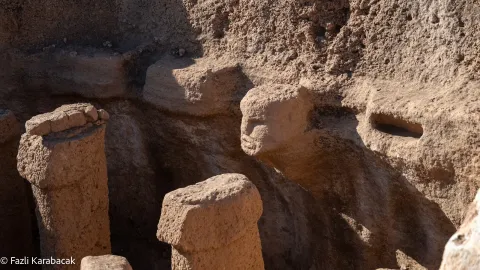
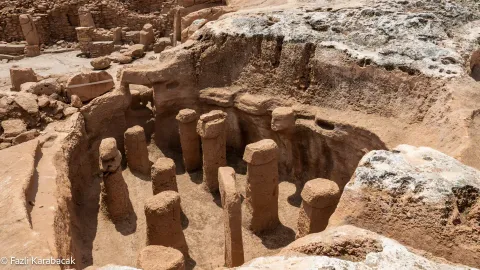
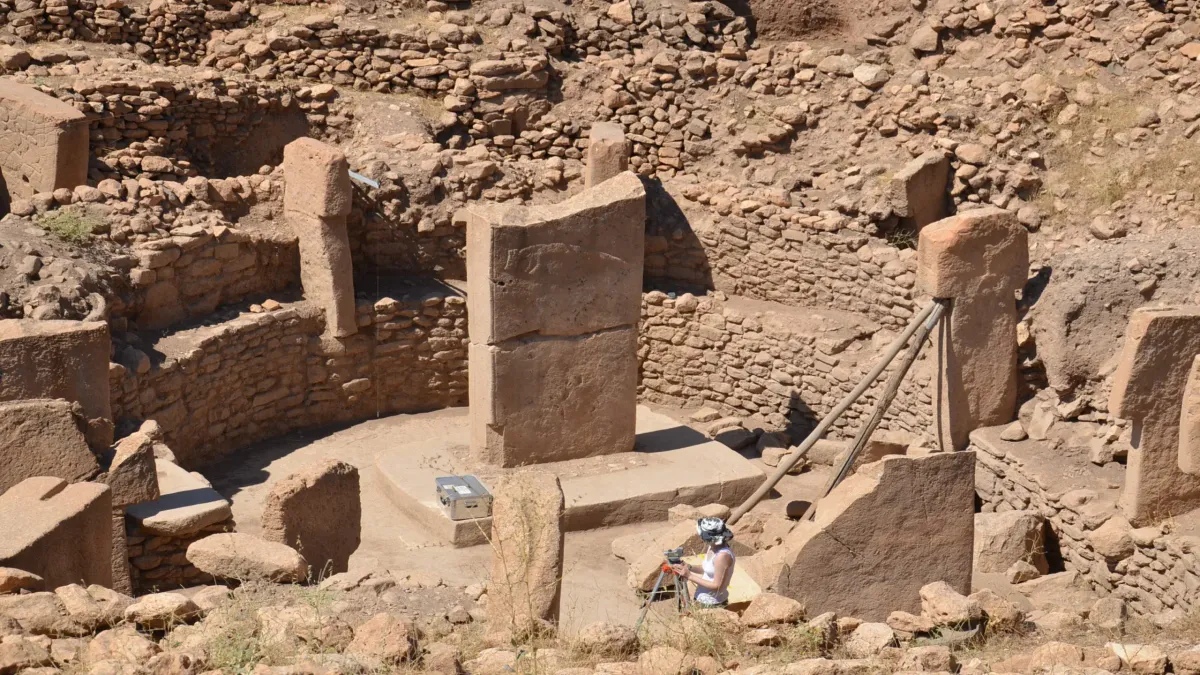
The T-shaped pillars stand in concentric rings. Each ring centres on two tall pillars facing each other, with smaller pillars forming the enclosure walls around them. The shapes are abstract — anthropomorphic, most likely — but the carvings are precise and deeply cut — foxes mid-stride, cranes in profile, bulls, scorpions, snakes, wild boar, vultures carrying what may be human heads. More than thirty species appear across the site.
Here is what does not make sense. The deepest level — Layer III, dating to around 10,000 BCE — contains the largest and most elaborate rings. Layer II, roughly two thousand years later, is smaller, simpler. The builders did not progress. They scaled back. And then, around 8,000 BCE, they buried the entire complex under tonnes of fill, carefully and deliberately. Why would hunter-gatherers return to a hilltop for two thousand years, building and rebuilding, and then choose to seal it underground? No one has answered that yet.
Constructing a single pillar ring required hundreds of workers coordinating over an extended period. The quarry sits on the same hilltop — you can still see an unfinished pillar lying in the bedrock, half-detached, as if the carvers set down their tools and walked away.
A Site Found Twice
A survey team first noted the hilltop in 1963. They recorded some surface finds and moved on. For three decades, Göbekli Tepe sat in the files as a low mound with scattered flints — nothing that justified a second look.
In 1994, Klaus Schmidt saw what the earlier team had missed. I met him a few years into the excavation, when the first enclosures were only partially exposed and there was nothing around the site but open steppe — just Schmidt, his team, and the stone. He had the quiet focus of someone who understood exactly what he was uncovering and knew it would take longer than one career to finish. He spent twenty years at Göbekli Tepe, every excavation season, until his death in 2014. Today the German Archaeological Institute and the Şanlıurfa Museum continue the work he started. Less than five percent of the complex has been uncovered.
Standing at Enclosure D
When I bring visitors to Göbekli Tepe now, I start at Enclosure D — the largest and oldest of the excavated rings, home to the tallest pillars on the site. The scale only registers when you stand next to them. Photographs flatten them. In person, the carved fox on Pillar 1 is at eye level, and the vulture stone — a relief that may depict the earliest known representation of death and the afterlife — sits just above your head.
From the platform beside the shelter roof, the Harran Plain opens up to the south. Twelve thousand years ago, this was not the semi-arid steppe you see today. The land was greener, wetter, full of the wild game that the pillars depict. The carved animals were not decoration. They were the world those builders lived in.
Twenty Years of Return Visits
I first came to Göbekli Tepe in the early 2000s. Schmidt was still actively directing the excavation, and the site received almost no visitors. Over the past two decades I have returned every season, each time with a different group — historians, archaeologists, documentary filmmakers, travellers who had read about the site and wanted to see it with someone who could put the stones in context.
Every visit is different because the excavation continues. New sections emerge each season. The questions multiply faster than the answers, which is part of what keeps drawing me back. Twelve thousand years ago, people walked to this hilltop carrying nothing but intent, and they raised stones that outlasted every civilisation that followed. Today visitors fly from the other side of the world to stand in the same spot. The impulse has not changed. Only the distance has.
If you’re planning a visit, the Göbekli Tepe visitor guide covers practical details on getting there, opening hours, and what to expect at the site. Thirty-five kilometres away, Karahan Tepe — discovered more recently and still actively excavated — makes a natural companion visit.
Frequently Asked Questions
Why was Göbekli Tepe deliberately buried? After roughly two thousand years of use, around 8,000 BCE, the entire complex was covered with tonnes of carefully placed fill. Archaeologists don’t fully understand why. It was not abandoned and forgotten — the burial appears to have been deliberate and respectful, perhaps a ritual closure. It is one of the most intriguing unsolved questions at the site.
How did hunter-gatherers organise the labour to build this? The buildings required coordinated labour, but the precise workforce and organisation are not established. Domestic evidence supports a settlement, so explanations should not assume that all workers lived elsewhere. Communal gatherings and resident activity need not be mutually exclusive.
How old are the animal carvings really? The oldest layer (Layer III, dated to around 10,000 BCE) contains the most elaborate rings with the most detailed carvings. Radiocarbon dating of charcoal from the site confirms dates within the range of 11,000–9,500 years ago. The precision of the carving — foxes mid-stride, cranes in profile — confirms these were not the first attempts but the work of artisans with established skill.
Is Göbekli Tepe proof that religion came before agriculture? No. The site shows early monumental construction during a major change in subsistence and social life. It does not establish a single causal sequence from religion to agriculture or settlement. Lee Clare’s excavation-team research summary provides context for the changing interpretation.
How much of Göbekli Tepe remains unexcavated? Less than five per cent of the site has been excavated. Ground-penetrating radar detected over twenty structures, but many remain buried. The excavation will likely continue for decades, and each new season brings new enclosures into view.
Why is the vulture stone significant? A relief that may depict the earliest known representation of death and the afterlife, the vulture stone sits on Pillar 43 in Enclosure D. Vultures carrying headless human bodies appear in multiple locations across the site, suggesting a symbolic system linking birds, death, and possibly ancestor veneration. It hints at a sophisticated worldview that archaeologists are only beginning to understand.