Quick Answer
Mount Nemrut, rising to 2,150 metres near Adıyaman in southeastern Turkey, holds the monumental tomb sanctuary of King Antiochos I of Commagene, built in the 1st century BCE. Colossal stone heads of Zeus, Apollo, Hercules, and the Persian goddess Commagene line the eastern and western terraces; earthquakes toppled them long ago, but they remain recognisable. The site is most visited for sunrise on the eastern terrace, when the light catches the weathered faces and the artificial mountain built over Antiochos’s burial chamber glows like a beacon. The climb is steep but short, and the experience is singular.
The Summit
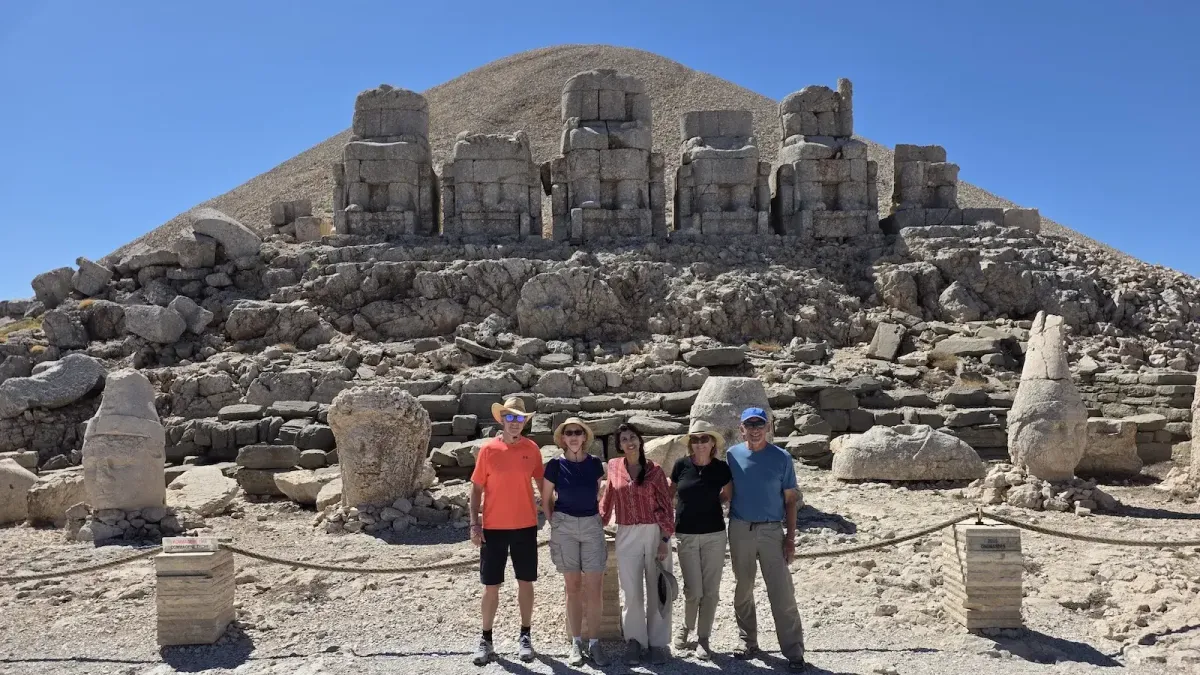
The climb to the top of Mount Nemrut takes time. The mountain stands 2,150 metres above sea level near the village of Eski Kahta, close to Adıyaman in southeastern Turkey. The last section is on foot, and by the time you reach the summit terrace, the effort has done something useful — it has separated you from everything below. What waits at the top is a tumulus of fist-sized stones, fifty metres high and a hundred and fifty metres across, flanked by colossal seated figures whose heads have long since toppled to the ground. They lie in the rubble, facing outward, still recognisable after two thousand years.
This was the Hierotheseion — the sacred tomb — of King Antiochos I of Kommagene.
The Kingdom of Kommagene
The territory between the Taurus Mountains and the Euphrates was called Kommagene in Greek and Roman times. It included the cities of Samosata, Perre, Doliche, and Germanikeia Kaisareia — an area covered today by the modern cities of Adıyaman, Maraş, and Gaziantep. Assyrian annals refer to the region as Kumuhu, the site of a Neo-Hittite kingdom.
Kommagene became an independent kingdom around 80 BCE under Mithradates I Kallinikos, who established his dynasty during the civil wars that brought down the Seleucid line. The kingdom flourished under his son Antiochos I, passed to Mithradates II, and lasted until 72 CE, when Vespasian incorporated it into the Roman province of Syria.
Arsameia and the Road to the Summit
The route to Mount Nemrut passes through Arsameia on the Nymphaios — a city discovered by Professor Friedrich Karl Dörner of Münster University during his systematic investigations of Kommagene. In 1951, Dörner found a monumental inscription cut into the rock on the south flank of Eski Kale, near Eski Kahta on the river Nymphaios, the present-day Kahta Çay.
The inscription names “the Great King Antiochos, God, the Righteous, Epiphanes, the Romanophile and Hellenophile” and records that this site was chosen by his father Mithradates Kallinikos as his sacred last resting place. It also reveals that Arsameia was founded by Arsames, an ancestor of Antiochos, and that the city had a fortifying wall and contained palaces.
Dörner’s excavations yielded a relief of exceptional quality: a 3.43-metre carving showing Mithradates Kallinikos shaking hands with Herakles, who in Kommagene also represented Ares and the Persian god Artagnes. The relief is half Parthian and half Greek in its iconography, entirely Greek in execution, and dates to around 50 BCE.
The Roman Bridge at Cendere
A few kilometres southwest of Arsameia, a handsome Roman bridge spans the Cendere Çay, a branch of the Kahta Çay. A Latin inscription on the columns records that it was built by four Kommagenian cities in honour of Septimius Severus, his wife Julia Domna, and his sons Caracalla and Geta. Four columns originally stood in two pairs on either side. The one erected for Geta is missing — almost certainly removed after Caracalla murdered his brother and ordered his name erased from all monuments.
The Royal Tumulus
About ten kilometres southwest of Arsameia stands a tumulus where the royal women of the dynasty were buried. Three Doric columns on its southern side are each topped with a carved animal — a lion, a bull, and an eagle. They overlook the Kahta Çay and are visible from the summit of Nemrut Dağ above. They date to the reign of Antiochos I, between 63 and 32 BCE.
The East Terrace
The tumulus at the summit is bounded on the east, west, and north by three terraced courts hewn from the living rock. The east court is the most important group. It is bordered on the west by the colossal seated statues, on the east by a pyramidal fire altar, and on the north and south by low walls of orthostates — upright stone slabs on a narrow base. The northern slabs bore reliefs of Antiochos’s Persian ancestors; the southern slabs portrayed his Macedonian lineage. In front of each relief stood an altar with a small fire basin. Most of the orthostates now lie in fragments, but Professor Dörner assembled and studied them, establishing the genealogical trees on both sides. Through his father Mithradates, Antiochos claimed descent from Darius I. Through his mother Laodike, he traced his line to Alexander the Great.
The steps of the pyramidal fire altar on the east side of the court are still partially preserved. Since 1953, the site has been systematically examined through excavations directed first by Theresa Goell on behalf of the American School of Oriental Research in New Haven, Connecticut.
The Colossal Statues
The seated figures on the east terrace reach eight to ten metres in height. Their block-like forms recall similar portrayals from the Hittite site of Yesemek, about fifty kilometres southwest of Gaziantep, on the old borders of Kommagene.
Each figure represents a deity formed by syncretism — the Macedonian practice, adopted from Alexander onward, of merging the gods of different peoples into a single type. The statues, from left to right, are: Apollo-Mithra-Helios-Hermes; Fortuna, the fertility goddess of Kommagene; Zeus-Oromasdes (Ahuramazda); Antiochos himself; and Herakles-Artagnes-Ares. An eagle and a lion stood at either end.
The heads of all the statues except Fortuna’s have fallen and now lie in sequence on the ground. They are finely carved in the idealised late Hellenistic style — handsome faces with noble features. The gods wear the Persian tiara and diadem. Antiochos and Zeus have lost the tops of their headdresses. A crown of fruits adorns Fortuna’s head, and she wears a veil.
The west terrace carries a matching row in the same sequence. The heads here are in better condition — Fortuna’s face, badly eroded on the east side, is well preserved on the west. So are the heads of Herakles, Zeus, and Apollo. The arrangement of ancestor orthostates differs on this side: the Macedonian ancestors face the statues, while the Persian ancestors line the southern border. Reliefs showing Antiochos shaking hands with each deity are well preserved on the west; on the east, only fragments survive.
The Lion Horoscope
One relief on the west terrace deserves separate attention. Professor Otto Neugebauer of Brown University analysed the lion carving and identified astronomical symbols: nineteen stars in the background and on the lion’s body, a crescent moon on its breast, and a conjunction corresponding to Jupiter, Mercury, and Mars. The date these signs indicate is July 7, 61 or 62 BCE — the date Antiochos was placed on the throne by the Roman general Pompey.
The North Terrace
The north terrace was a processional way linking the east and west courts. Slabs lying on the ground were once part of a wall three metres high and eighty metres long, with an entrance in the centre giving access to a ramp leading from the valley to the summit. A colossal eagle statue guarded the entrance.
Trenches dug into the tumulus show that it was piled on a rocky hill, and it is probable that the remains of Antiochos I were preserved in a chamber cut into the living rock beneath the stones. That chamber has not yet been found.
A king who merged two bloodlines and half a dozen gods into his own identity, then built his tomb at the point where the mountains of southeastern Turkey meet the sky. The heads have fallen. The throne inscriptions are fragmentary. The sunrise still reaches the east terrace first, exactly as he intended.
Frequently Asked Questions
When was Mount Nemrut built, and how long did construction take? Antiochos I ruled Commagene from 70–36 BCE and built the summit sanctuary as a funerary monument to himself. Ancient sources do not specify how long construction took, but given the scale and the height of the location, it likely took years or decades. The artificial tumulus alone covers a hectare and rises fifty metres—an enormous earth-moving project.
Why did Antiochos build on a mountain rather than in a city? The height and isolation served both practical and symbolic purposes. A mountain sanctuary was visible from great distances—a literal monument to immortality. It placed the tomb beyond reach of grave robbers. And it positioned Antiochos physically between the earth and the heavens, reinforcing his claimed relationship with the gods he depicted.
Is Antiochos’s burial chamber really still there? Excavation trenches show a chamber was cut into the bedrock beneath the tumulus, but archaeologists have never located the entrance. It may remain sealed, or it may have been looted in antiquity. The puzzle remains one of the site’s enduring mysteries.
What does the lion horoscope on the west terrace mean? The lion carving includes nineteen stars, a crescent moon, and planetary symbols that scholars have decoded as marking July 7, 61 or 62 BCE—the date Pompey installed Antiochos on the throne. It is one of the oldest known astrological representations and shows how Antiochos used the monument to commemorate political and cosmic significance.
Can you visit both sunrise and sunset? Technically yes, but it is exhausting. Most visitors choose sunrise (the experience is more dramatic, with light emerging slowly over the Mesopotamian plain). Sunset is warmer and less logistically demanding but the light effects are less dramatic. The site is open to sunset visitors, though fewer go that late in the day.
What is Arsameia, and is it worth visiting? Arsameia was the summer capital of Commagene, located on the river Nymphaios about forty minutes’ drive from Mount Nemrut. It contains relief carvings (including a 3.4-metre carving of King Mithradates shaking hands with Herakles) and an important monumental inscription. It contextualises Mount Nemrut within the wider Commagene kingdom.