Quick Answer
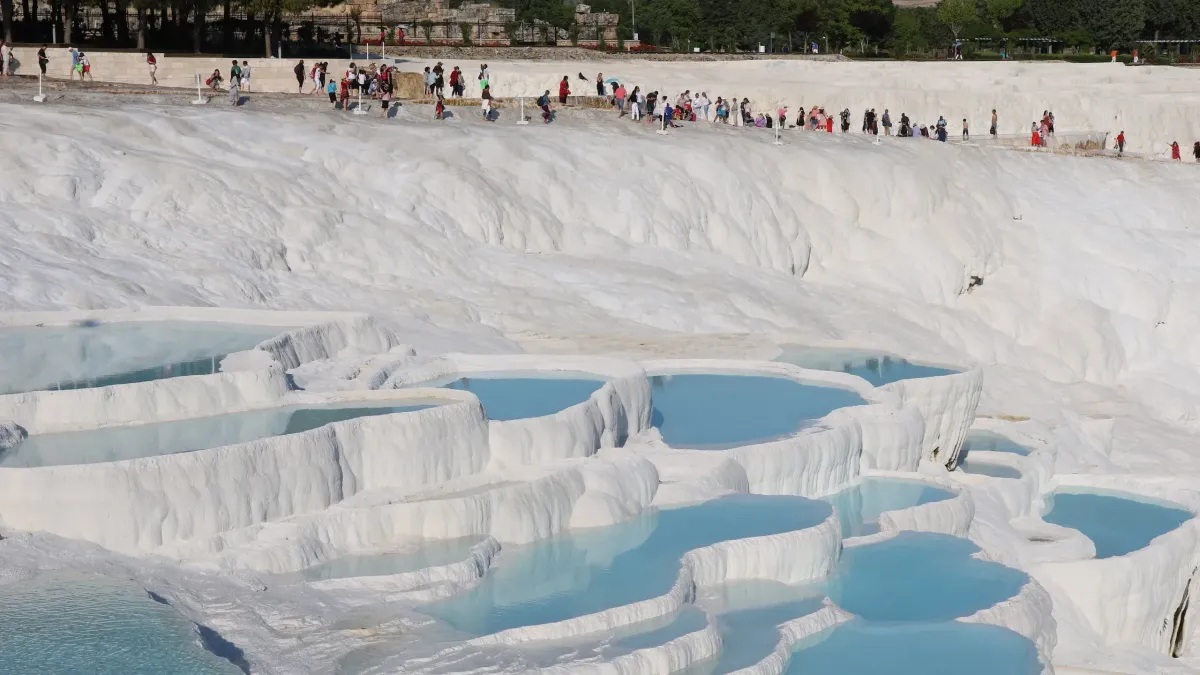
Pamukkale—Turkish for “Cotton Castle”—is a travertine plateau in southwestern Turkey where thermal water rising at 35°C precipitates calcium salts to form cascading white pools. Perched above sits Hierapolis, an ancient Roman city founded in the 2nd century BCE and reaching its peak in the 2nd–3rd centuries CE. The travertines are visually spectacular; Hierapolis tells a deeper story of Roman engineering, urban planning, and cultural continuity. Most visitors see the pools and leave; those who spend time in the ruins discover an entire city—theatre, baths, temples, necropolis—where commerce, worship, and daily life were layered vertically on unstable ground.
The Terraces
The site of ancient Hierapolis sits 22 kilometres from Denizli on a plateau of white travertine — called Pamukkale today, literally “Cotton Castle,” for its appearance. Hot water rises from underground in four springs at 35 degrees centigrade, saturated with calcium salts and carbon dioxide. As the water cools, the salts precipitate and form the travertine layers. The water flows from mountaintop springs through natural and man-made channels, then follows the terrain’s contours down to a lower elevation. Because this process has continued for millennia, the water has formed terraced steps — each resembling a miniature waterfall with a shallow pool behind it. Stalactites form where the calcified water overflows the basins.
Throughout its history, this site has drawn people seeking remedy, beauty, and rest. The waters are popularly believed to help with heart, circulatory, nervous, kidney, rheumatic, and paralytic complaints and to condition the skin. The thermal water was even used in dyeing wool and cotton — the calcium salts it contains act as effective mordants.
I bring groups here regularly, and I always advise visitors to spend time at the ancient city above the terraces, not just at the pools. The travertines are the reason most people come. The ruins of Hierapolis are the reason they wish they had stayed longer.
History
The name Hierapolis — “Holy City” — comes from the temples and religious structures that once filled the site. Ancient writers could not agree whether the city belonged to Lydia, Phrygia, or Caria. Saint Paul placed it in the southwest of Phrygia, near the Carian border, northwest of Colossai. Strabo and Ptolemy called it Phrygian, like Laodicea and Tripolis. The Byzantine author Stephanus noted it was a holy place with many temples that had ceased to function under Augustus.
Before Hellenistic times, we lack definite information about the site’s name, though early settlement is attested and reference is made to a sacred cave — the Plutonium — and the Magna Mater cult practised there.
The city was most likely founded by King Eumenes II of Pergamon in the second century BCE and may have taken its name from Hiera, wife of Telephos, the legendary founder of Pergamon. The Plutonium was almost certainly the nucleus around which the Hellenistic city grew. The oldest inscription found on the site is a decree honouring Eumenes’ mother, Apollonis.
In 133 BCE, the city was bequeathed — along with the entire Pergamene kingdom — to Rome by King Attalos III. The region, notoriously seismic, suffered a devastating earthquake in 60 CE under Nero, but the disaster became the occasion for complete rebuilding. Further earthquakes struck under Antoninus Pius and Alexander Severus.
Hierapolis reached its peak in the second and third centuries. It was rebuilt entirely, losing all Hellenistic character and becoming thoroughly Roman. Ancient sources indicate the city flourished in metalwork, stonework, and woollen textiles — carpets, fabrics, and flowers. Rich deposits of polychrome marble were quarried and exported. The emperors Hadrian and Caracalla are believed to have visited.
Constantine the Great made Hierapolis the capital of the Phrygian region. Christianity spread rapidly; the apostle Philip is said to have been martyred here in 80 CE. During Byzantine times, the city was an episcopal see, and a large church was erected in Philip’s name.
The Seljuk Turks briefly captured Hierapolis toward the end of the twelfth century before the Byzantines retook it. Byzantine control ended finally in the fourteenth century, after which the city appears to have been abandoned.
Scholarly History
The earliest European reports date to the late seventeenth century — brief references by J. Spon, G. Wheler, and T. Smith. R. Pococke described the buildings in the early eighteenth century, particularly the theatre and nymphaeum (which he incorrectly identified as a temple of Apollo). R. Chandler visited in 1764 with an architect and artist, publishing more detailed observations in Reisen in Kleinasien (Leipzig, 1776). De Laborde drew the theatre in 1838; Charles Texier published the first details of the monument reliefs in 1839. The foundational scholarly work remains Altertümer von Hierapolis, published in Berlin in 1898 by Humann, Cichorius, Judeich, and Winter.
Regular excavations began in 1957 under Paolo Verzone. Italian archaeologists continue the work under Daria de Bernardi Ferrero.
The Ruins
Hierapolis was built on the Hippodamos grid — streets running parallel and intersecting at right angles. The city covers roughly 1,000 by 800 metres. Since virtually the entire Hellenistic city was destroyed by earthquakes, most visible remains are Roman.
Main Street and City Gates
The main street runs nearly a kilometre north to south, dividing the city in two. Colonnades and public buildings lined both sides. At each end stand monumental gateways in the form of victory arches flanked by towers. The southern Byzantine Gate — a four-towered structure — dates to the fifth century. The northern gate is a triple victory arch with round towers, bearing a Latin and Greek inscription dedicating it to the emperor Domitian — hence “Arch of Domitian.” It was erected by Julius Sextus Frontinus, Roman proconsul of Asia in 82–83, and is also known as the “Arch of Frontinus.” A third gate, the Northern Byzantine Gate, stands where the main street intersects the later-period wall and dates to the second century.
City Walls
In the late fourth century, defensive walls encircled the northern, southern, and eastern sides — built from materials scavenged from earlier structures, enclosing an area corresponding almost exactly to the original Hellenistic city. Twenty-four square towers reinforced them. Besides the two monumental gates, two smaller entrances provided access to the Martyrion, the eastern necropolis, the aqueduct, and the cisterns.
Baths
Hierapolis had two city baths. The first and larger is the structure encountered on approach — well preserved, with massive walls, vaulted chambers, and traces of marble facades. The layout is typical of Asia Minor: a large entrance courtyard, an enclosed rectangular palaestra with ceremonial halls on either side, a long hall for athletics, and the bath proper — caldarium, tepidarium, and frigidarium under vaulted roofs. Heat came from furnaces, conducted by pipes in the walls. Wide windows provided additional warmth. This complex dates to the second century; a small vaulted room adjoining the main hall now serves as a museum.
A second bath was built outside the northern gate in the early third century. During the early Christian period — probably the fifth century — it was converted to a church.
Aqueducts and Fountains
Two aqueducts — channels cut through surrounding hills — supplied drinking water: one between Pamukkale and Karahayıt, the other toward Güzelpınar. Their stone cover slabs are still visible in places. The channels met in a filtration chamber on a hill east of the city, from which earthenware pipes distributed water to buildings.
Three monumental fountains (nymphaea) have been found. The largest, at the city entrance, presumably served passing caravans and was later incorporated into the fourth-century city wall. A second, smaller nymphaeum stood in the city centre. The third — later, well preserved, and richly decorated — stands within the peribolus of the Apollo temple, built from reused materials, probably late third or early fourth century.
The Apollo Temple and the Plutonium
Apollo was the principal deity of Hierapolis, though his sister Artemis and mother Leto were also worshipped. Artemis was venerated not merely as the Greek goddess of the hunt but in her Ephesian form. Non-Greek gods were worshipped with local titles and attributes.
The temple to Apollo was built over the Plutonium — a cave of great antiquity and religious significance. According to legend, Apollo met Kybele, the Anatolian mother goddess, at this spot. An excavation team found the mouth of the Plutonium in 1964. The entrance, framed by a semicircular marble vault, leads to an underground cavern from which poisonous gases emerge. Strabo tells us the priests used these vapours to stage “miracles.”
Coins and inscriptions show the people of Hierapolis also worshipped Dionysos, Herakles, Men, Euposia, Tyche (the city’s patron), and Nemesis. The Apollo temple’s visible remains date to the third century, though the foundations go back to late Hellenistic times. The temple measured roughly 20 by 15 metres. Only the pronaos, cella, and parts of the peribolus survive.
Theatre
The theatre visible today was most likely built under the Flavian emperors during the rebuilding that followed the earthquake of 60 CE, replacing an earlier theatre to the northeast. Located east of the Apollo temple, it is the best-preserved structure at Hierapolis.
About thirty rows of seats survive, set against the hillside. The auditorium is divided by a double diazoma and could seat fifteen to twenty thousand. The cavea and skene date to the Flavian period; an inscription in the cavea gallery places further work under Hadrian. Under Septimius Severus, the skene was modified — foundations reinforced, a columned facade added. The richly ornamented skene had five doors, five niches, and ten columns with marble decorations carved in the form of oyster shells.
A restoration in 353 probably converted the orchestra into a pool for mock naval combats.
Both limestone and marble were used. The city’s inhabitants contributed considerable effort, but the lavishness of the decorations left parts of the project unfinished.
Athletic and Artistic Life
As in other Roman cities of Asia Minor, sports at Hierapolis served as propaganda and a demonstration of loyalty to Rome. Athletic competitions were held every four years in honour of Apollo — running, boxing, and wrestling were added in later years. Literary and musical contests were also held, with victors awarded metal crowns. Representations of these games appear on city coins from the mid-third century onward.
The most significant monument to athletic life is a relief found in the central part of the theatre stage, showing Septimius Severus and his family watching sacrificial and award ceremonies alongside the city’s tutelary deities.
Martyrion of Saint Philip
Located outside the city walls, this octagonal building dates to the late fourth or early fifth century. Built on a 20-by-20-metre square, it honours Saint Philip, believed to have been martyred in Hierapolis. After Christianity became the state religion, the site became a place of pilgrimage. Philip’s actual grave has not been discovered.
The building is approached by a broad stairway. Eight chapels are separated by polygonal rooms. Outer rooms connect to a central chapel and octagonal area, forming a double cross. The central space, about 20 metres in diameter, was originally covered with a dome of lead plates on a wooden frame. The sides were covered with brick vaults interspersed with wooden roofs.
Necropolis
The Hierapolis necropolis is one of the best-preserved ancient cemeteries in Turkey. It extends about a kilometre on either side of the road beyond the Arch of Frontinus. Tombs span late Hellenistic to early Christian times and divide into three types: sarcophagi (many inscribed, some with decorative reliefs depicting the occupant), tumuli (circular mounds with a passage leading to a round vaulted chamber, dating from the second century BCE to the first century CE), and house-shaped tombs on square or rectangular plans.
The variety reflects the occupants — not only the wealthy and notable but the ordinary as well. Inscriptions record the name and profession of the deceased, their good works and charities, followed by pleas and testaments.
Agora
East of the main street between the Arch of Frontinus and the Northern Byzantine Gate, the agora measures roughly 200 by 130 metres, now lying below two metres of sand. A large building on the eastern side, with a semi-columned Ionic facade decorated with masks and garland elements, has been restored. The dimensions and construction quality confirm this as the city’s principal commercial space.
Economic Life
Philostratus, writing in the mid-third century, called Hierapolis one of the most flourishing cities of Asia Minor. Despite earthquakes and a second-century plague, prosperity rose steadily from founding through the late Imperial period. The thermal springs aided the wool-dyeing trade. Polychrome marble was quarried and exported — Byzantine sources mention its use in the construction of Constantinople’s Hagia Sophia and in imperial sarcophagi.
Local workshops produced everyday pottery, while craftsmen also made high-quality small vases and oil lamps for ritual use. Before the agora was built near the Arch of Frontinus, ateliers and kilns in that area produced “Megarian bowls” — relief-decorated vessels featuring flowers, plants, mythological figures, and scenes.
Visiting
Pamukkale rewards visitors who go beyond the terraces. The necropolis, the theatre, the Plutonium, and the main street together form one of western Turkey’s most complete Roman cityscapes. The thermal pools are where visitors start. The ancient city above is where the site reveals its depth.
Frequently Asked Questions
Can you swim in the travertine pools? Some pools at Pamukkale are open to visitors for bathing; others are protected. The modern Pamukkale Thermal Park allows swimming in warm pools. The mineral-rich water is warmer at the springs (35°C) and cools as it flows across the terraces. Bathing is pleasant, though the water temperature drops significantly by the time you reach the lower pools.
Why is the Plutonium so significant? The Plutonium is a cave mouth from which toxic volcanic gases escape. Ancient priests used these gases to stage “miracles” — animals brought near the opening would collapse, suggesting divine power, while the priests (who held their breath) appeared unaffected. It is a clever use of geology to maintain religious authority. The Plutonium was the nucleus around which the city grew.
How many earthquakes has Hierapolis suffered? Hierapolis sits in a seismic region. Major earthquakes are documented in 60 CE (under Nero), 262 CE (under Valerian), and others throughout its history. Despite repeated destruction, the city was rebuilt each time, suggesting its economic importance. The marble trade and wool dyeing kept it valuable enough to restore.
Why was Hierapolis built on such unstable ground? The thermal springs were the attraction — they had medicinal reputation and served the wool-dyeing trade. The location was so valuable that despite earthquakes, residents chose to rebuild repeatedly rather than relocate. This is a case where geology mattered more than structural stability.
What is a Megarian bowl, and where can I see them? Relief-decorated vessels from the Hellenistic period produced in Hierapolis workshops. They featured flowers, plants, and mythological scenes in fine detail. Examples are housed in museums in Denizli and Istanbul. The local pottery tradition was high-quality, and these bowls represent artisan craftsmanship.
How long should I spend at Pamukkale and Hierapolis? A full day allows time for the travertine pools and a meaningful exploration of the ruins. Rushing both in a few hours means choosing between visual spectacle and archaeological depth. For serious archaeology, allow 3–4 hours at Hierapolis alone (theatre, necropolis, main street, temples).