Quick Answer
Troy is a mound of thirty settlement layers stacked vertically over four thousand years near Çanakkale in western Turkey. Heinrich Schliemann excavated it starting in 1870, convinced he would find Homer’s Trojan War. He was wrong about the date and the treasure, but right about the location. The archaeological evidence shows a city destroyed by fire at roughly 1300–900 BCE—the right period for Homer’s war—but whether the Trojan War actually happened remains unknowable. What is certain: Troy was strategically important, repeatedly destroyed and rebuilt, and its fame in literature outgrew its actual size by an order of magnitude that persists today.
The Hill at Hisarlık
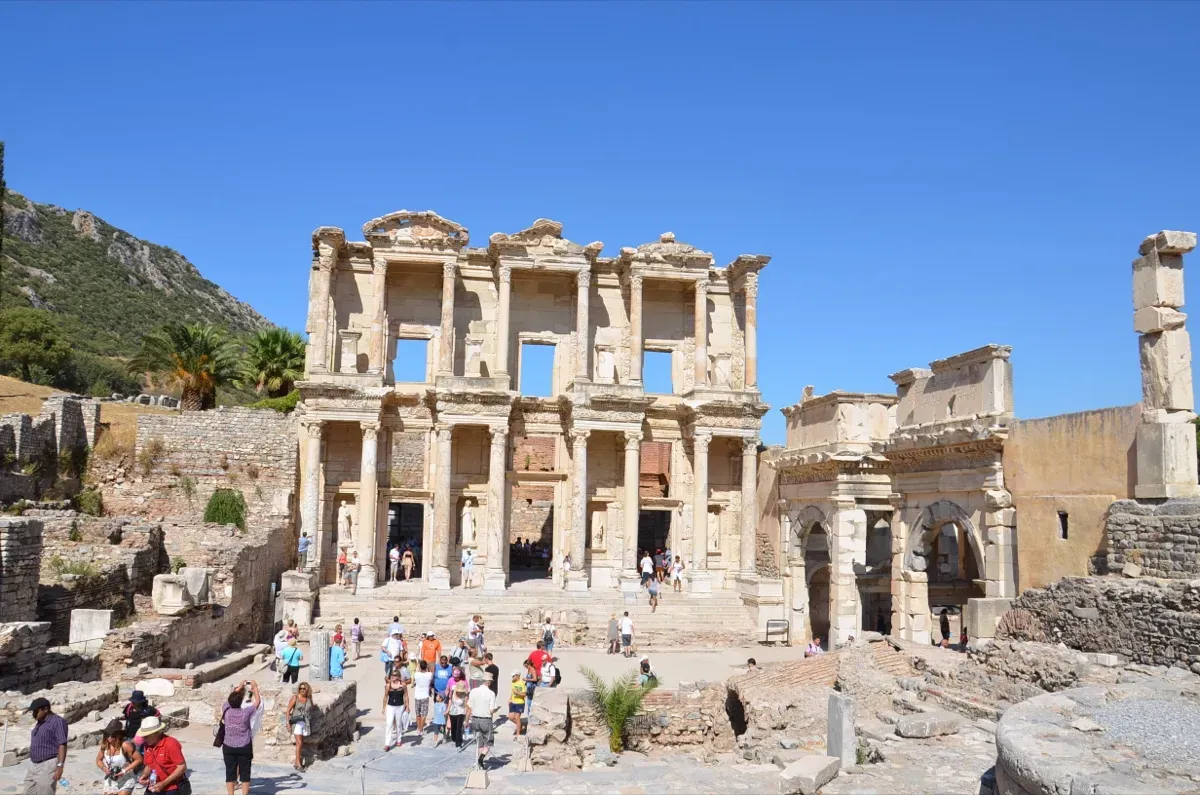
Troy is not a ruin you walk into and immediately understand. The citadel mound sits on the edge of a fertile plain near Çanakkale, modest in size, layered in ways that only make sense once someone points at the exposed cross-sections and explains what each stratum represents. Visitors who come expecting a city on the scale of Ephesus are often surprised. Troy is small. But its importance was never about size.
How It Was Found
Heinrich Schliemann was not an archaeologist in the modern sense — he was a wealthy businessman obsessed with proving that Homer’s epic described a real place. In 1870, he drove the first spade into the mound at Hisarlık. Ten metres down, his great North-South Trench cut through a burnt layer belonging to the second building period. Schliemann was convinced he had found the city of Priam and the traces of the Trojan War. The golden objects he pulled from that layer, he declared to be Priam’s treasure.
He was wrong about the date and wrong about the treasure. But he was right about the location.
In 1882, Schliemann gained the collaboration of Wilhelm Dörpfeld, an experienced excavator from the Olympia digs. Dörpfeld imposed proper method on the chaos and distinguished nine distinct layers of civilisation in the mound. Between 1932 and 1938, American archaeologist Carl Blegen led a new campaign with more refined techniques and subdivided those nine layers into thirty separate habitation levels. Troy was not one city. It was thirty, stacked on top of each other over four thousand years.
The Trojan War Question
Archaeologists place the conflict described by Homer — if it happened — in the seventh layer, roughly 1300 to 900 BCE. Homer composed the Iliad approximately five hundred years after the war it describes. How much is memory and how much is invention remains open.
The outline is familiar: Paris, son of King Priam, takes Helen to Troy. Her husband Menelaus and his brother Agamemnon marshal a Greek alliance and lay siege for ten years. Achilles and Hector fight and die. Odysseus ends it with the wooden horse. The city burns.
What makes Troy interesting is not whether the story is true in every detail. It is that the mound at Hisarlık shows a city at the right level, in the right period, destroyed by fire. The physical evidence and the literary tradition overlap just enough to sustain the question without settling it.
What You See Today
The site rewards patience more than spectacle. There are remnants of massive fortification walls from multiple periods, a paved chariot ramp that once led to one of the citadel gates, and exposed layers of successive construction visible in the trench profiles. Below the mound, the plain stretches toward the Dardanelles — a plain that was once a harbour, long since silted up by the river Scamander.
I tell visitors to look at the plain as much as the stones. Imagine it full of water, with ships drawn up on the shore. That is the landscape Homer described. The scale of the citadel makes more sense when you realise the sea once came to its feet.
Frequently Asked Questions
Did the Trojan War really happen? The question cannot be definitively answered. The archaeological evidence shows a city (Troy VIIa) destroyed by fire around 1300–900 BCE — the right date and the right kind of destruction. But archaeology cannot prove that this destruction was caused by Greeks or that the siege lasted ten years. The Iliad contains historical echoes, but it is a poem, not a chronicle. The safest answer: something happened at Troy that became legendary.
How many cities are buried in the Troy mound? Carl Blegen’s excavation identified thirty distinct occupation levels. Some lasted centuries, others only decades. Nine major occupation phases are culturally distinct enough to be considered separate “cities.” The mound is essentially a vertical history of the region spanning four thousand years.
Why did Schliemann think he had found Priam’s treasure? Schliemann excavated a cache of golden objects and declared them to be Priam’s treasure. He was wrong on multiple counts: the objects dated to a much earlier layer (Troy II, around 2400 BCE), not the Trojan War era. His excavation methods were destructive and damaged earlier layers. And the “treasure” was likely ritual or trade goods, not a royal hoard.
How long should I spend at Troy? Two to three hours allows you to walk the main structures and understand the site’s layout. The museum on-site adds another hour. A guide who can explain the stratigraphic layers transforms the visit from “rocks on a hillside” to coherent history. Without context, the site is harder to read than more visually impressive ruins.
Can I visit Troy and Gallipoli on the same day? Yes. They are roughly sixty kilometres apart near Çanakkale. A day tour would cover both, though neither would feel rushed. Troy typically takes 2–3 hours; Gallipoli’s ANZAC sites take 2–4 hours depending on depth. Combining them makes logistical sense.
Why is Homer’s accuracy or inaccuracy important? It matters because it affects how we interpret the physical evidence. If Homer was describing actual historical events, archaeological findings should line up with his narrative. When they don’t, we learn about the gap between memory and imagination — how legends grow from real events. Troy is valuable for that lesson as much as for what it reveals about the Bronze Age.