Quick Answer

Göbekli Tepe was almost certainly not a temple in the modern sense, but it was not an ordinary settlement either. After thirty years of excavation, no hearths, storage bins, or living floors have been found. The strongest evidence points to a specialised communal ritual site—a place where Pre-Pottery Neolithic hunter-gatherer groups gathered periodically to feast, build, and carve meaning into stone. Whether you call that a “temple,” a “sanctuary,” or something else depends on your definitions, but what is unambiguous is this: people chose a hilltop deliberately, invested enormous labour, and created a space that guided human experience through architecture.

Was Göbekli Tepe a Temple? The Short Answer

No — Göbekli Tepe was almost certainly not a temple in the modern sense. But it was not an ordinary settlement either. After 30 years of excavation, no hearths, storage bins, or living floors have been found. The strongest evidence points to a specialised communal ritual site — a place where hunter-gatherer groups gathered periodically to feast, build, and carve meaning into stone.

That is the shortest careful answer. The rest of this article explains what it actually means when you are standing inside the enclosures.


The Question Every Visitor Asks

Within the first ten minutes of every Göbekli Tepe tour I lead, someone asks: “Was Göbekli Tepe a temple?” Sometimes it comes as the group steps onto the viewing platform. Sometimes it arrives earlier, in the minibus on the way from Şanlıurfa.

It is the right question. And after more than 25 years of guiding this site — from the days when Klaus Schmidt was still pulling pillars from the earth, through the canopy construction, through the discovery of Karahan Tepe — I have had a long time to think about the best honest answer.

This is not the academic version. This is the guide’s version: what the debate tells you when you are standing inside one of those enclosures, stone under your feet, pillars above you, and twelve thousand years of silence in between.


Quick Facts for Visitors

  • Short answer — Almost certainly not a temple in the modern sense, but not an ordinary settlement either
  • What it probably was — A periodic ritual gathering place for mobile hunter-gatherer groups
  • The debate — Klaus Schmidt (sanctuary) vs. Ted Banning (decorated domestic buildings)
  • Strongest evidence — No hearths, no storage, no domestic refuse — after 30 years of excavation
  • The Karahan Tepe factor — Nearby sites with domestic structures make Göbekli Tepe’s absence of them even more striking
  • What it means for your visit — How you read each enclosure changes completely depending on where you stand in this debate

Was Göbekli Tepe a Temple or a Settlement? What the Scholars Argued

You do not need to read the journals to benefit from this debate. But knowing the outline sharpens what you see on site.

Klaus Schmidt’s Case: A Hilltop Sanctuary

Schmidt — who spent nearly two decades excavating here before his death in 2014 — was determined from early on that this was not a settlement. Three things struck him:

The location makes no practical sense for a village. The ridge is high, exposed, and has no natural water source nearby. People chose it for visibility, not convenience.

The architecture is unlike anything from residential Neolithic sites. The T-shaped monolithic pillars, the organised enclosure walls, the carved reliefs — none of it fits the pattern of a home.

And most tellingly: after decades of careful excavation, there are no domestic features. No hearths. No grain storage. No sleeping floors. No rubbish middens of the kind any inhabited settlement produces. Schmidt’s conclusion was that groups living in the surrounding lowlands travelled to this hilltop periodically to build, feast, and perform rituals — then returned home.

“First came the temple, then the city.” — Klaus Schmidt

Ted Banning’s Challenge: Decorated Houses?

In 2011, Ted Banning of the University of Toronto published a paper that asked an uncomfortable question: how do we know that “sacred” and “domestic” were separate categories at all for Neolithic people?

His argument was not that Göbekli Tepe was unimportant. It was that the assumption — monumental + symbolic = sanctuary — may project modern Western thinking onto a society that did not divide the world that way. He pointed to ethnographic examples of elaborately decorated communal houses around the world that combined ritual and domestic life.

It was a valuable intervention. It is why I never tell visitors “Schmidt proved it was a temple.” He did not prove it. He made the strongest case the evidence supports.

Where the Current Consensus Stands

Most archaeologists now lean toward the ritual interpretation, while accepting Banning’s caution about rigid categories. The physical record is simply too consistent: thirty years of excavation, multiple enclosures, and still no hearth, no storage bin, no sign of domestic occupation.

For me, visiting Karahan Tepe settled any remaining doubt about Göbekli Tepe — but I will come to that.


What Visitors See Inside the Göbekli Tepe Enclosures

This is the part that does not appear in the journal articles.

Standing in Enclosure D

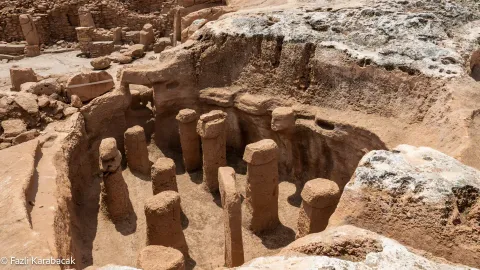
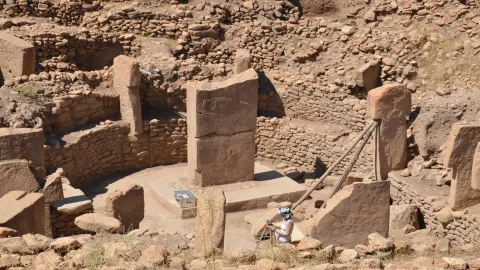
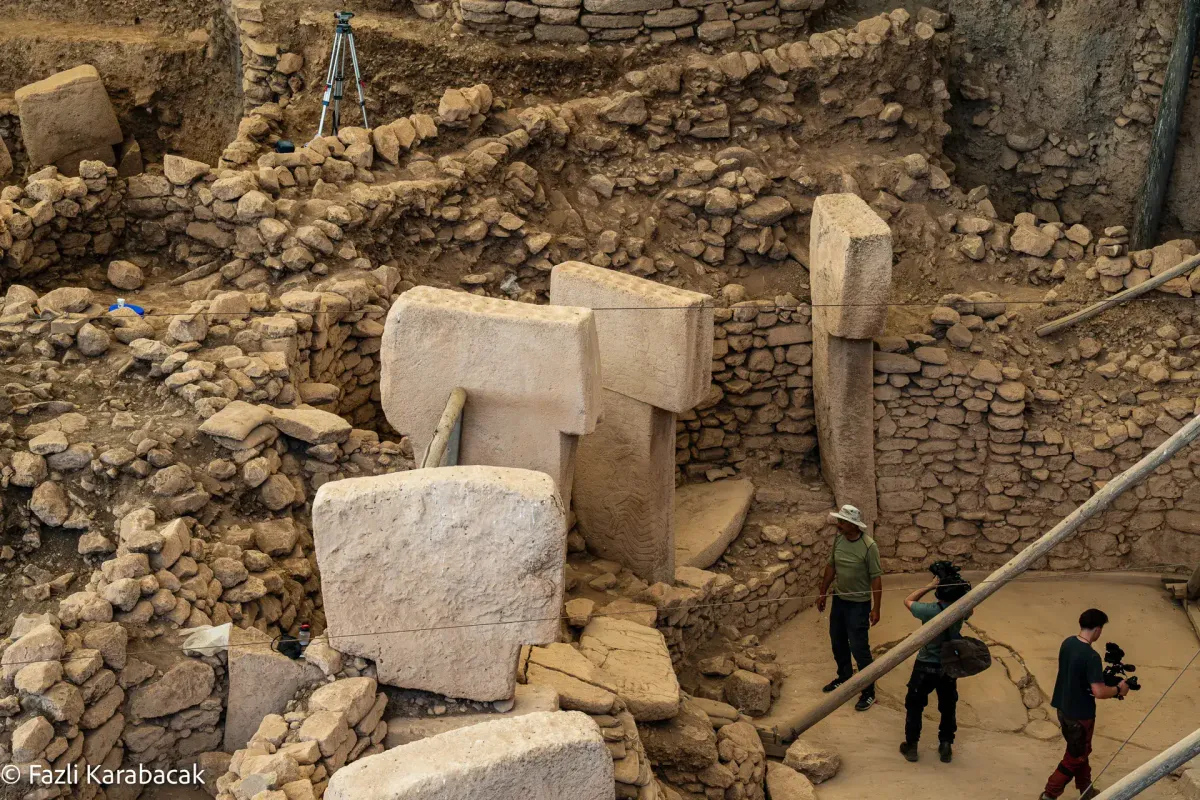
Enclosure D is the largest and most elaborately carved structure currently open to visitors. The two central T-pillars are over five metres tall. When you stand between them, the standard visitor question — “was this a temple?” — starts to feel like the wrong framing.

What you feel is directed space. The narrow entrance, the bench running around the interior wall, the way the central pillars dominate the room — everything organises your body and your attention toward a focal point. That is not accidental. It is architecture that produces a specific kind of experience.

Whether you call that experience “religious” or “ritual” or “communal” says more about your vocabulary than about the space. The space itself is unambiguous: it was built to make people feel a particular way.

The Absence You Cannot See

The most important thing at Göbekli Tepe is invisible to most visitors: what is not there.

No fireplace. No ash pit. No broken cooking pots. No storage area. No sleeping area. Wherever you look in the excavated enclosures, the archaeology of daily life is absent.

I always point this out explicitly on tour. Because once you know to look for it, the silence of that evidence becomes its own kind of presence. This was not a place where people lived. It was a place they came to.

The Quarry on the Same Hilltop

Walk to the northeast edge of the site and you can see where the pillars were cut. A fifteen-tonne limestone pillar, half-detached from the bedrock, lies where the quarriers left it. Just above it: the completed enclosures.

The builders quarried stone, worked it on site, and erected the finished pillars without ever moving them off the ridge. This tells you the hill itself was the destination — not merely a convenient quarry.


How the Şanlıurfa Museum Changes the Question

I always pair a Göbekli Tepe visit with the Şanlıurfa Archaeology and Mosaic Museum, and this debate is part of why.

The museum holds the richest Pre-Pottery Neolithic collection in the world, including finds from Göbekli Tepe. What you see there fills in the invisible layer for which the site itself offers no physical trace.

The Totem Pole figure — a life-sized limestone statue of a Neolithic person, eyes inlaid with obsidian — is the kind of object that adjusts your sense of what these builders were capable of symbolically. This is not a society in an early stage of representational thinking. They were sophisticated makers and communicators of meaning.

The small carved objects from the site — animal figurines, stone vessels, worked bone — build a picture of material culture that the enclosures alone cannot give you. And crucially, the museum contextualises what daily life looked like at nearby settlements from the same period: it clearly did not look like Göbekli Tepe.


Karahan Tepe: The Site That Changed How I Answer the Question

When serious excavation began at Karahan Tepe — about 35 kilometres southeast of Göbekli Tepe — I realised that the temple/settlement debate had just been handed its most useful new evidence.

What Karahan Tepe Has That Göbekli Tepe Does Not

Karahan Tepe has monumental pillar buildings. But it also has clear domestic structures: smaller buildings with the marks of everyday habitation, organised differently from the ceremonial spaces.

For the first time, we can look at two sites from the same cultural horizon, built by related communities, and see what each type of architecture looks like. Domestic space is recognisable. Ritual space is recognisable. They are different.

What This Means for Göbekli Tepe

Once you have been to Karahan Tepe and seen what domestic Neolithic architecture looks like in this region, the absence of it at Göbekli Tepe stops being an absence and becomes an argument.

These communities knew how to build houses. They chose not to build them here. That choice says something.

A Combined Visit Makes Both Sites Richer

I now recommend visiting Göbekli Tepe and Karahan Tepe on the same trip — not just because of logistics, but because the comparison is intellectually irreplaceable. Each site reads differently when you have seen the other. On our Göbekli Tepe and Karahan Tepe tour, we structure the itinerary specifically to let this comparison develop over the day.


What to Look For on Your Visit

Given everything above, here is what I suggest paying attention to when you are at the site:

In the Enclosures

  • The entrances — narrow, deliberate, controlling who and how many enter at a time
  • The bench line — a low stone bench runs the interior of each enclosure; not for sleeping, probably for gathered participants
  • The absence of fire — stand in the centre of an enclosure and notice there is nowhere a hearth could have been without leaving traces

On the Pillars

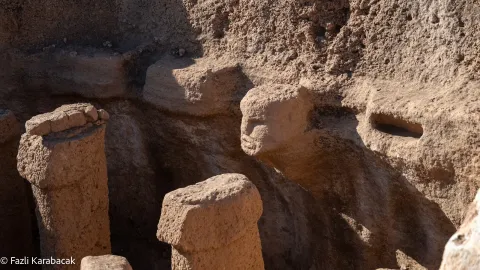
  • The arms and hands — look closely at the central pillars in Enclosure D; the T-shape is a stylised human figure, arms at the side, hands visible above the belt
  • The belt and loincloth — these are not decorative. They are clothing. The builders were representing persons, not abstract shapes
  • The animal reliefs — note what animals are chosen; they are predominantly dangerous, liminal, or associated with death (foxes, vultures, snakes, scorpions). These are not domestic animals. They are not food animals. They were chosen symbolically.

At the Viewpoint

  • The horizon — look south toward the Harran Plain. This was the world the builders came from. The hilltop was chosen to be above and apart from that world.
  • The unfinished pillar in the quarry — it was abandoned mid-cut. Whatever ended the use of the site, it ended quickly enough that one team left their work unfinished.

My Answer After 25 Years

When a visitor asks me whether Göbekli Tepe was a temple, I give them an honest answer that has evolved over many years:

It was a place that mattered in a way ordinary places do not — and the people who built it made that distinction deliberately and at enormous cost.

Calling it a temple imports assumptions about priests, congregations, and organised religion that almost certainly did not exist in the Pre-Pottery Neolithic. The builders had no writing, no city-state, no religious hierarchy we can identify.

But calling it a settlement is equally misleading. It was not where anyone lived. It was where people came.

The most precise description available is: a specialised communal gathering place — somewhere that mobile hunter-gatherer groups returned to, over a period of roughly two thousand years, to build, to feast, to carve, and to enact whatever forms of collective meaning-making shaped their world.

That may be less satisfying than a one-word answer. But I promise that standing inside Enclosure D — with that understanding rather than without it — is a more complete experience.


Plan Your Göbekli Tepe Visit

If this has sharpened your interest in seeing the site with this context in place, the following are the most practical next steps:

  • Combined archaeology tour — Our Göbekli Tepe and Karahan Tepe day tour visits both sites with the comparison in mind
  • Şanlıurfa base — All our Göbekli Tepe tours depart from Şanlıurfa, where we can also arrange the museum visit
  • Longer itinerary — The Treasures of Ancient Turkey tour places Göbekli Tepe within a broader arc of Turkish archaeological sites

Frequently Asked Questions

Was Göbekli Tepe a temple or a settlement?

Göbekli Tepe was most likely a specialised communal ritual site, not a temple or a settlement in the modern sense. No domestic architecture has been found after 30 years of excavation. The enclosures were visited periodically and treated as fundamentally different from everyday domestic space.

Did anyone live at Göbekli Tepe?

No evidence of permanent habitation has been found. No hearths, storage areas, or living floors. The builders almost certainly lived in the surrounding lowlands and travelled to the hilltop for periodic ritual gatherings.

How does Karahan Tepe compare to Göbekli Tepe?

Karahan Tepe has both monumental pillar buildings and domestic structures, which Göbekli Tepe lacks entirely. This direct comparison from the same culture makes Göbekli Tepe’s purely ritual character even more significant.

Is it worth visiting both Göbekli Tepe and Karahan Tepe?

Yes — visiting both sites on the same day is the best way to understand each one. The comparison is intellectually irreplaceable. Seeing what domestic Neolithic architecture looks like at Karahan Tepe transforms how you read Göbekli Tepe’s enclosures.

How long should I spend at Göbekli Tepe?

Allow at least two hours on site, plus travel time. Combined with the Şanlıurfa Archaeology Museum, plan a full day. A guided tour helps focus the visit around the questions that matter most.


Sources Consulted

  • Schmidt, K. (2006). Sie bauten die ersten Tempel. Beck.
  • Banning, E. B. (2011). “So Fair a House: Göbekli Tepe and the Identification of Temples in the Pre-Pottery Neolithic of the Near East.” Current Anthropology, 52(5), 619–660.
  • Dietrich, O., & Notroff, J. (2015). “A Sanctuary, or So Fair a House? In Defense of an Archaeology of Cult at Pre-Pottery Neolithic Göbekli Tepe.” In Defining the Sacred, 75–89.
  • Renfrew, C. (1985). The Archaeology of Cult: The Sanctuary at Phylakopi. British School at Athens.
Share

Stay curious

Subscribe for expert insights on Turkey's ancient sites and cultural heritage.